From Roots to Realization
Luna McMahon
- Digital Collage
Digital Collage
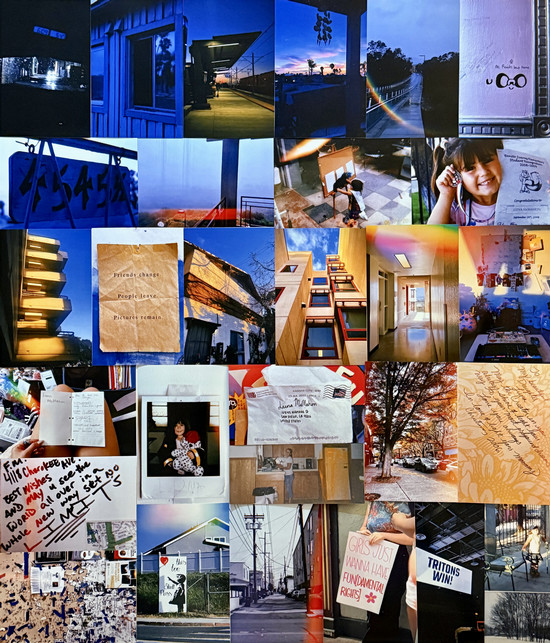
My therapist says I live in the future. It is somewhat ironic, considering that my Gallup Strengths assessment lists “Futuristic” as one of my top three traits. I attribute this to the hustle mentality I adopted at a young age. I became comfortable, perhaps too comfortable, living for the future rather than embracing the present. As a first-generation student, I’ve experienced firsthand the struggles of navigating college applications and learning to create a FAFSA account for both myself and my parent with no guidance.
In my piece, From Roots to Realization, I wanted to capture the evolution of my perspective as a first-generation student through color and imagery. My initial images reflect moments of solitude like sitting in my car on a rainy drive home and learning to deal with difficult days. A sunset picture from my front door, once overlooked, took on new significance after moving off campus. A window near my room, the UCSD trolley stop, and the path to the Hopkins parking structure, all places I once rushed through, became visual markers of my journey. In the beginning, I was overwhelmed by the unknown, struggling both academically and socially. Over time, I longed for the creativity I once had while attending the San Diego School of Creative and Performing Arts. I had lost my artistic way in my pursuit of academia, but rediscovered photography and began documenting the duality of my surroundings at UCSD. Most times I found similarities by linking campus spaces, such as the Brennan Hall stairway, to personal memories, like the color scheme of my Tía’s apartment.
Photography taught me how much representation matters and not just in images, but in the spaces we navigate. That realization extended beyond my art and into my advocacy. As a first-generation student, I wanted to make sure others like me felt seen and supported. Whether it was through my work as a Marketing Intern for the Undocumented Student Services Center, AS Local Affairs Director, or Student Ambassador for San Diego County Behavioral Health, I committed myself to ensuring that our struggles and triumphs weren’t invisible. My 'Girls Just Wanna Have Fundamental Rights' image from the Women’s March stands as a testament to that effort.
Additionally, I’ve always believed in signs, fate, and the power of words. Two written messages have guided me: one from my mother, urging me to dream profoundly, and another from my late brother, who passed away in 2020 and inspired me to commit to UCSD. His message—“set no limits”—is a mantra I practice daily, including in this artistic project. Traditionally, I consider myself a portrait photographer, but this project pushed me beyond that. I captured candid shots, such as a childhood notebook page titled “How to Get Into College,” written in the sixth grade, and scraps of paper left on a UCSD bulletin board. These became reminders to me of the importance of leaving an impact, no matter how small as we may never know what they could mean in the future.
Losing my childhood home further influenced my imagery, emphasizing a letter with my previous address, the alleyway to my old home, and an image of my mother washing dishes. With my passion for words, three signs stood out: “Friends change. People leave. Pictures remain.” “This too shall pass.” And most profoundly, “All roads lead home.” That final message resonates deeply as I transition into my next adventure—graduate school.
Being first-generation, I never imagined the immense gratification of committing to a master’s program. My undergraduate years were often misunderstood by family and friends, as my time was consumed by relentless effort. But it was all for the future. The trees in my final images represent my next step, Cornell University for a Masters in Healthcare Administrations. I hope to leave a lasting impact, not only at UCSD or Cornell but for all first-generation students who doubt their ability to succeed. May my journey serve as a reminder that we belong in these spaces and that our roots, no matter where they start, can grow into something extraordinary